Six engagements, in full.
Each one starts with what was stuck, names the broken link, and shows the movement in the business. Platform metrics sit underneath as support, never as the headline.
Supplements, Australia — 30 days to April 2026. The platform export behind these figures.
Shown in full and uncropped when supplied.
Found A$18,342 a month of spend that was buying nothing, inside an account reporting 4.5x.
Real return on click was 2.1x. Fifty eight per cent of the budget sat below break even.
Multi-SKU ecommerce, Australia — May 2026. The platform export behind these figures.
Shown in full and uncropped when supplied.
A$252,375 of tracked revenue from A$60,827 of spend in a single month, at 4.15x blended.
Shopping ran at A$17.10 per conversion while a A$1,500 daily budget went unspent next to it.
Chauffeur services, Melbourne — 1 to 19 March 2026. The platform export behind these figures.
Shown in full and uncropped when supplied.
173 booked enquiries in 19 days at A$18.66 average cost per lead, across two accounts.
Both accounts converted above 22%. Both were capped by budget, not by performance.
Healthcare lead generation, US — May 2026. The platform export behind these figures.
Shown in full and uncropped when supplied.
Two of nine campaigns were live, and those two were producing three quarters of the leads.
The cheapest converting asset in the account was the one being restricted by its daily budget.
The account spent $1,168.07 and produced 40 conversions at a blended $29.20. Seven of nine campaigns were paused or disapproved, which sounds like neglect until you read which two were still running. They were the two best in the account.
The best campaign returned $16.31 per conversion at a 19.61% conversion rate and delivered half of all conversions on its own. It was also capped, showing limited by budget and missing a lead form extension, so the cheapest converting asset in the account was the one being restricted. Meanwhile a paused campaign had spent $489.71 for six conversions at $81.62 each, five times the cost of the winner.
The recommendation was not to rebuild the account. It was to raise the daily budget on the capped winner from $15 to between $25 and $30, add the missing extension, and rebuild the one campaign that had already proved it could not convert. Fixing what is working is faster than fixing what is broken, and it is usually cheaper.
Fragrance ecommerce, UK — January 2023. The platform export behind these figures.
Shown in full and uncropped when supplied.
£11,398 in a month at £8 per conversion, with the real leak sitting in the checkout.
Four in ten people who began a checkout finished it. The ads had already been paid for.
The store did £11,398 across 296 orders at a £35 average order value, from 9,300 users. Google Ads carried it: £2,030 of spend producing 250 conversions at £8 each on a 5.88% conversion rate, driving 4,000 of those users. Meta added 86 conversions from £1,150.
The number that mattered was further down. Eleven thousand sessions produced 715 checkout starts, and 715 checkout starts produced 296 completed orders. Four in ten people who began a checkout finished it. At a £35 average order value, the 419 people who started and abandoned represented roughly £14,600 of demand the ads had already been paid for.
More budget was the obvious move and the wrong one. The account was acquiring intent efficiently at £8. The business was losing it after the click, which is a cheaper problem to fix and pays back on traffic already bought.
Twelve campaigns, four languages, one negative keyword architecture that keeps the whole account clean.
Six themed shared lists in the manager account, applied across the campaign set — and deliberately not uniformly. Clean traffic is what let the account hold that return across four markets.
A B2B fashion wholesale account running across German, French, Italian and English markets. Twelve campaigns spanning brand and non-brand Search, dynamic search ads on collections, a wholesale campaign and two Performance Max campaigns.
An account of that shape attracts a specific kind of waste. Job seekers, retail consumers searching for high street brands, sourcing agents looking for manufacturers, and traffic from supplier marketplaces. Every one of those looks like a qualified query at first glance and none of them buys wholesale.
I built six themed shared negative keyword lists in the manager account and applied them across the campaign set: Brand Terms, Apparel and Textile Manufacturing, Clothing Brands, Competitor B2B Fashion Suppliers, Generic Terms, and Manufacturers Platform. Every new irrelevant search term gets assigned to its theme rather than blocked individually, so the lists stay organised, reporting stays consistent, and the protection applies to every campaign at once instead of being rebuilt twelve times.
The structure is deliberately not uniform. The wholesale campaign keeps the framework but runs a modified Generic Terms list, so it blocks "free" while keeping "wholesale". The Performance Max competitor campaign has the competitor and clothing brand lists removed entirely, because targeting those brands is the campaign's purpose. Applying every list everywhere would have been tidier and would have broken two campaigns.
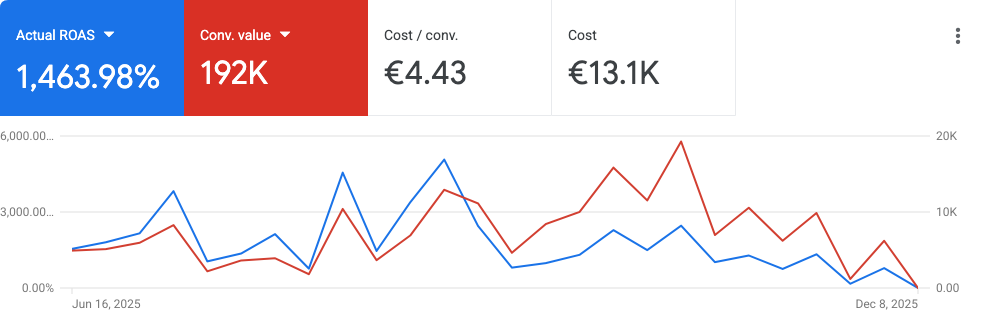
Across the period the account returned €192K of conversion value on €13.1K of spend at €4.43 per conversion — 1,463.98% in the platform's own reporting. The export sits above, uncropped.
The exports, uncropped.
Platform reporting from accounts I have run, shown whole rather than cropped to a flattering band. Each caption states the account, the platform, the figure on the card and the exact period.

1,463.98% ROAS · €192K conversion value from €13.1K
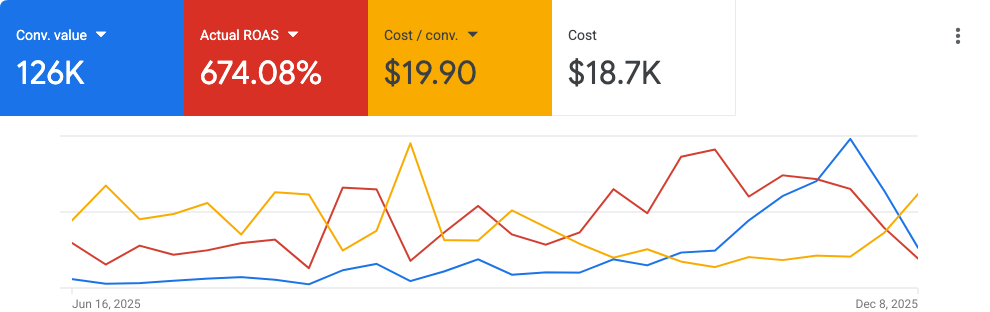
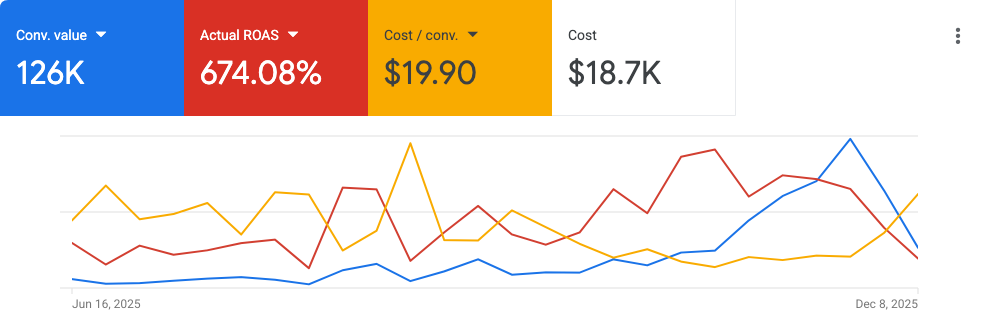
674.08% ROAS · 126K value from $18.7K at $19.90 per conversion
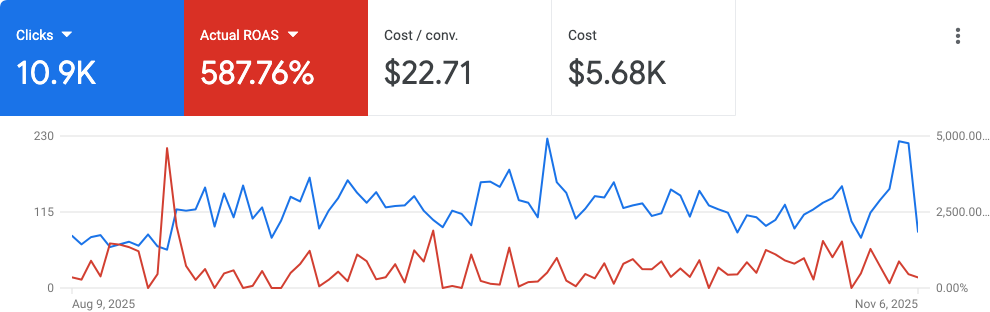
587.76% ROAS · 10.9K clicks at $22.71 per conversion
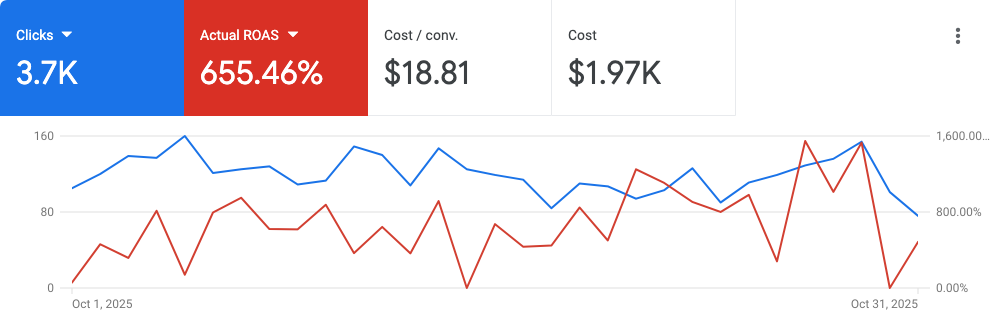
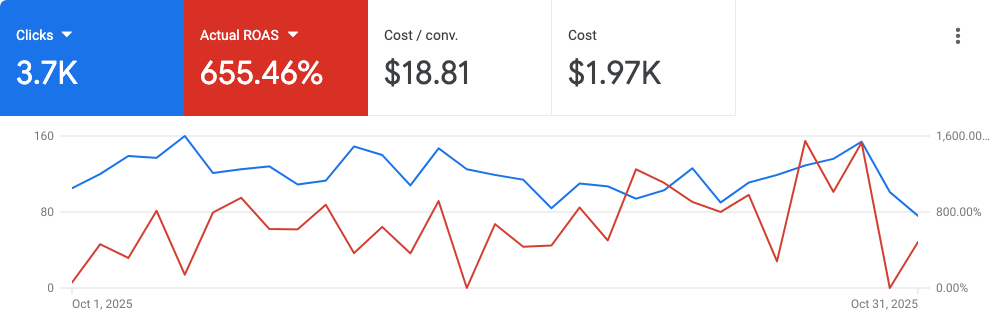
655.46% ROAS · 3.7K clicks at $18.81 per conversion
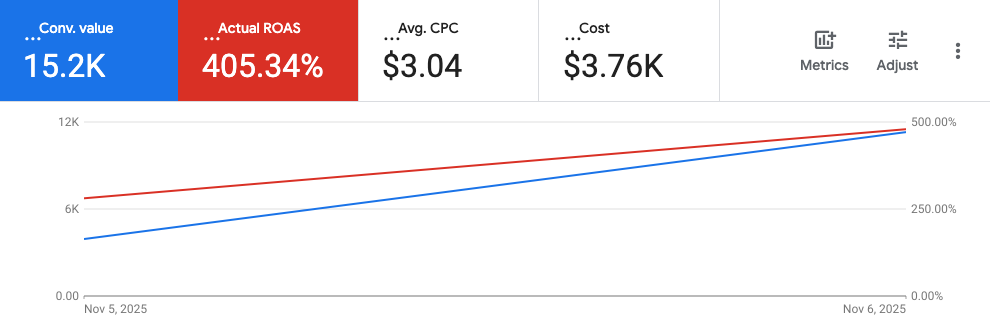
405.34% ROAS · 15.2K value from $3.76K at $3.04 CPC
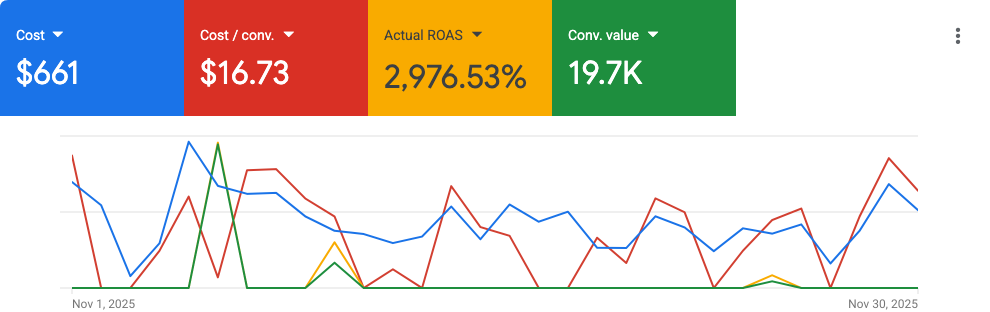
2,976.53% ROAS · 19.7K value from $661 at $16.73 per conversion
Accounts are shown by category. Client names go up only where the client has given written permission; two of the accounts on this page are held under confidentiality and stay anonymised regardless.
The account is rarely the problem. But the account is where the evidence is.