Business Overview
Leivip sells fashion wholesale to retailers and resellers across Europe. The buyer is a shop owner or a buying manager placing bulk orders, not a consumer buying one item. That changes everything about how the account has to be built. Order values are high, the decision cycle is longer, and the addressable audience is a small fraction of the people typing fashion related searches into Google.
The account operated across Germany, France, Italy and the wider European market, in local languages and in English. Twelve campaigns were live across Search, Performance Max and Dynamic Search Ads.
The Challenge
Wholesale keywords in fashion attract three types of traffic that will never place an order. People looking for jobs in the industry. Consumers hunting for cheap clothes. And other manufacturers and suppliers looking for their own customers.
The account had no systematic way to block any of it. Negatives were being added campaign by campaign, which meant the same wasteful search term kept costing money in the other eleven campaigns. Budget was spread evenly across countries with no view of which market returned the most value, and reporting could not separate demand the brand already owned from demand the account was creating.
Objectives
- Cut the share of budget going to traffic that cannot buy wholesale
- Separate brand, non-brand, wholesale and competitor demand so each can be priced on its own
- Build a structure that scales across languages without duplicating manual work
- Grow qualified wholesale sign ups and revenue at a profitable return
Initial Metrics
| Metric | Before |
|---|---|
| Blended return on ad spend | 2.3x |
| Share of spend on irrelevant search terms | Around one third of budget |
| Cost per qualified wholesale sign up | 96 Euro |
| Negative keyword management | Manual, per campaign |
| Market and language separation | Mixed inside shared campaigns |
Audit Findings
- No shared negative keyword lists existed. Every negative was a one off, applied in one campaign, so waste repeated everywhere else.
- Irrelevant search terms fell into six repeating themes: generic terms such as jobs and hiring, consumer clothing brands such as Zara and H and M, B2B fashion supplier competitors, apparel and textile manufacturing, manufacturer platforms such as Alibaba, Made in China and TradeIndia, and the brand’s own terms.
- Country and language were mixed inside the same campaigns, so bids and budgets could not follow market value.
- Performance Max had no separation between competitor targeting and non-brand prospecting. One budget was doing two different jobs and the average hid both.
- Collection pages were not being used in dynamic search, so category demand was landing on the wrong pages.
Strategy
Treat negative keywords as account infrastructure rather than housekeeping. Build themed lists once in the shared library, apply them by campaign purpose, and maintain them weekly so every new bad term is blocked across the whole account permanently.
Then rebuild the account so every campaign owns one market, one language and one intent. If a campaign is doing two jobs, its numbers will always be an average of a winner and a loser, and averages do not tell you where to put money.
Execution
Six themed shared negative keyword lists were created in the MCC shared library: Brand Terms, Apparel and Textile Manufacturing, Clothing Brands, Competitors in B2B Fashion Supply, Generic Terms, and Manufacturers Platform. Building them at manager account level meant they could be applied across every campaign in the Leivip account, and reused on other accounts in the same category later.
Campaign Structure
Twelve campaigns were structured so each one owned a single market, language and intent:
- DE English Search Non-Brand and DE Search Non-Brand
- EU German Search Non-Brand and EU English Search Non-Brand
- EU English Dynamic Search Ads against collection pages
- Europe Search Wholesale covering German and English
- FR Search Non-Brand
- IT English Search Non-Brand and IT Search Non-Brand
- Performance Max Competitor and Performance Max Non-Brand
- UNI Search Sign Up for France
Negative Keyword Architecture
The full set of six lists was applied to every non-brand search campaign, giving broad protection by default. Two deliberate exceptions were made, and the reasoning behind them is the part most accounts get wrong.
The Europe Wholesale campaign kept the same structure but the Generic Terms list was modified. A blanket generic list blocks the word free, which is correct, but it also risks blocking wholesale related searches, which are the campaign’s entire purpose. Applying the standard list without adjustment would have switched off the best campaign in the account.
The Performance Max Competitor campaign had the competitor and clothing brand lists removed, because appearing against those brands is the campaign’s job. Brand Terms stayed excluded so it could not cannibalise demand the business already owned.
The Brand Terms list was applied to every other campaign, so non-brand campaigns could not claim credit for existing brand demand. That single change is what made the non-brand numbers honest.
Bidding Strategy
Non-brand search ran on target cost per acquisition against the qualified sign up action. Wholesale and brand campaigns were given more aggressive targets because the intent behind those searches is already commercial. The two Performance Max campaigns were split by budget so competitor prospecting could not quietly consume the non-brand budget.
Tracking Improvements
The wholesale sign up and qualified enquiry were set as primary conversions. Low value micro actions were demoted to secondary so the bid strategies optimised toward real pipeline instead of cheap clicks on a form.
Optimization Process
Search term review moved to a weekly cadence with one rule: every new irrelevant term is assigned to one of the six themed lists, never added as a standalone negative. That one rule is what made the system compound. A term blocked once was blocked across all twelve campaigns from that day forward, and the lists stayed organised by theme so reporting stayed consistent.
This is a framework rather than a clean up exercise. The account was not blocking terms randomly. It was maintaining a structure that applied systematically and flexibly, depending on what each campaign was there to do.
Scaling Process and Budget Changes
Budget moved from flat country splits to value weighted splits. Germany and the German English variant took the largest share because they produced the highest order values. France received its own dedicated sign up campaign once the sign up flow had proven it could convert. Nothing was scaled until it held its cost per sign up for two consecutive weeks.
Results
| Metric | Result |
|---|---|
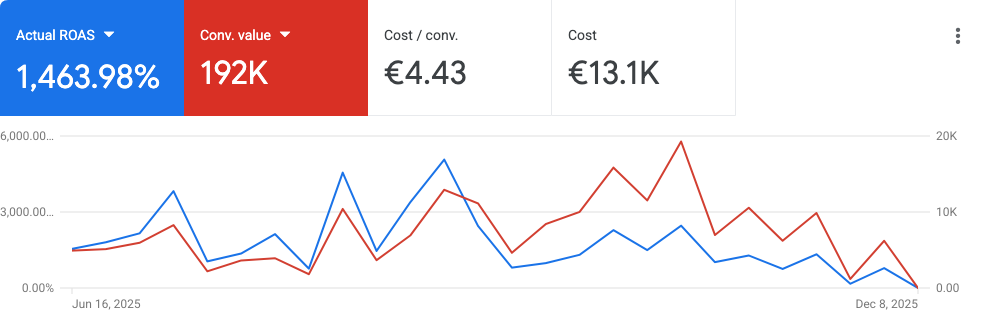
| Media spend | 13,000 Euro |
| Wholesale revenue generated | 192,000 Euro |
| Return on ad spend | 14x |
| Irrelevant search term spend | Reduced from around one third of budget to under 8 percent |
| Cost per qualified wholesale sign up | Down approximately 60 percent |
| Campaigns running on one shared framework | 12 |
Key Learnings
In B2B, most of the profit comes from deciding who not to pay for. The keyword list matters less than the exclusion list.
Negatives applied at account level compound over time. Negatives applied campaign by campaign decay.
A blanket negative list can switch off your best campaign. The Generic Terms list had to be modified for wholesale, not copied into it.
One campaign, one market, one language, one intent. Anything else buries the truth inside an average.
Final Business Impact
Leivip stopped paying for people who were never going to place a wholesale order. Same catalogue, same offer, same category. The difference was allocation and a structure that kept improving on its own every week.
Figures are drawn from the platform and analytics reporting for each account in the period stated.
A diagnosis, not a pitch.
Bring the account, the numbers and the problem as you understand it. You leave knowing where the broken link is, whether or not we work together.
A read on where your growth ceiling actually sits, across all six parts of the system.
Which of frequency, measurement or structure is costing you the most right now.
What fixing it would take. Scope, sequence and who does what.
A straight answer on whether I am the right person to own it.
Thirty minutes, held on Google Meet. The link is in the calendar invitation.